
Most difficult languages in the world

Neither linguists, nor polyglots can come to the same opinion about which languages are the most difficult to learn. There are a few such languages and each of them is complicated itself. Lots of things depend on what languages a person knows. Anyway, all these languages are even spoken by kids, so there is nothing impossible).
What languages are acknowledged as the most difficult?
1. CHINESE
The Chinese language is one of the languages among the top ratings, and it is a real challenge even for polyglots. It’s the Chinese language that is recognized as the most difficult by the Guinness Book of Records. This is owing to the special writing system – the writing of hieroglyphs, their number (about 85,000), and the specific phonetics, and in many dialects of the Chinese language. Interestingly, dialects are sometimes so far apart that their speakers simply may not understand each other, whereas news on the Internet is comprehensible to read, since the meaning of the hieroglyph is the same, regardless of its different pronunciation.
2. ARABIC
The main difficulty in learning Arabic is also writing. It’s very unusual for most people, as the text is written from right to left. There are only 28 letters in the Arabic alphabet, but most of them are written differently depending on a position within a word – at the beginning, middle and end. In addition, the spelling uses a “tashkil” – icons placed above or below the letters to indicate their sound.
There are three numbers in the grammar of a language– singular, plural, and dual. Phonetics is also very complex, as there are many sounds produced from the throat, and for each sound there are four tones, each of which can change the semantic meaning of a word!
3. RUSSIAN
There are many reasons for difficulties in learning Russian.
So, the stress can be both at the beginning of the word, and in its middle or on the last syllable. This is complicated by the fact that the stress of a word can “wander” in different forms. In French, for example, the stress in all words, except for a few borrowed ones, is on the last syllable, which is very convenient for learners. And the French language isn’t unique in this. Many languages have a similar rule, for example, in Armenian.
The pronunciation of a vowel in Russian can also vary depending on whether it’s stressed or unstressed. Although there is no clue. The accents need to be remembered.
The vocabulary of the Russian language and the variety of synonyms can also be confusing (bewildering). This is often due to the fact that there are many borrowed words in the Russian language. And this is not a sign of weakness, but a strength of a language, which gives both greater diversity in the expression of thoughts and greater understanding of other people. The same plant, for example, can have both a Latin name, and a native Russian, and some other foreign one.
What about commas that drastically change a meaning of the whole sentence? How about multiple meaning of words, depending on context and stress? What about the letter «ё», that is basically changed in texts on «е», but it’s vital to understand that this «ё» and read a word correctly. Interestingly, that for this reason in Russia the surname of the founder of psychoanalysis is still pronounced incorrectly: «Фрейд», instead of «Фрёйд» – it was printed in first editions, so it used to be pronounced like this, as this foreign surname wasn’t upon hearing.
The case of a verb represents a separate difficulty, and the pronunciation of the letter: «ы» can simply not be given. This letter doesn’t exist in majority of languages. At times, achieving the pronunciation required is doable by this unusual exercise: you need to hit yourself sharply in your stomach with your fist.
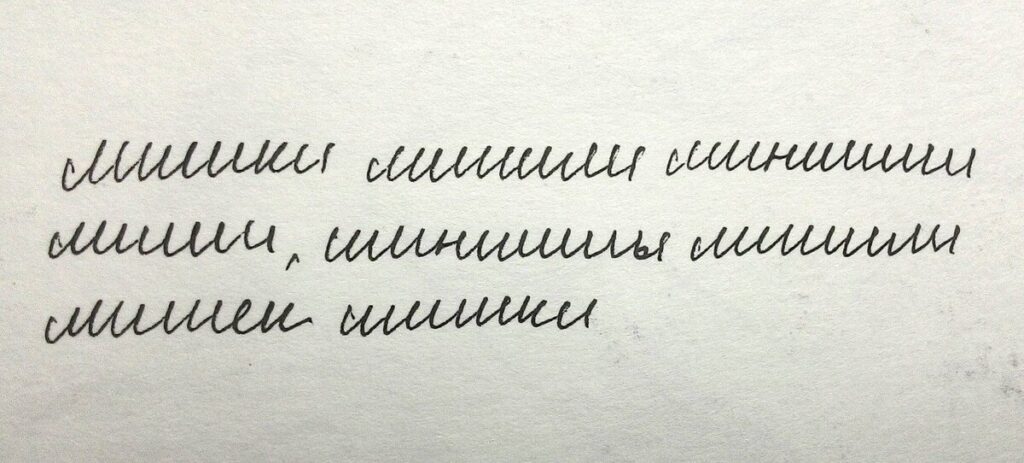
Russian writing is becoming a nightmare for many foreigners – it is often difficult to single out each letter separately in order to read a word. What if the word is unfamiliar or incomprehensible in context? This greatly complicates the learning process.
But there are also advantages for Russian language learners.
Easy reading is practically “what I see is what I pronounce.” Yes, there are many nuances, but you will always be understood if you read exactly according to this principle. You don’t have to keep a strict word order – almost everything can be swapped, which won’t change the content of a sentence, but intonation will be more important. For the same reason, it’s easier to write poetry in Russian by choosing a rhyme.
4. THAI
It is difficult to learn Thai because of the peculiarities of its tonal sound. They can turn a polite word into an offensive one. It takes a lot of time to master the five keys and learn how to distinguish them.
The fact that the alphabet consists of 32 vowels and 44 consonants isn’t the most difficult thing! You need to remember 4 more signs to indicate tones and hooks for other meanings, of which there are 8. A large number of consonants of the Thai language have 2-3 sounds, depending on the position in a word. And the invisible “a” and “o” at first, without exaggeration, require the presence of the sixth sense.
How do you like the fact that all the words in a sentence are written together?
The fact that only quotation marks and parentheses are represented in Thai doesn’t make it easier, but only complicates its study in this matter.
5. HUNGARIAN
The Hungarian language is a real puzzle not only for its students, but also for scientists. It doesn’t resemble any of its related languages. There are not many letters in it – 40, 14 of which are vowels, but word formation becomes a puzzle that forms new words with the help of more than the twenty cases of verbs.
Words are formed by adding case endings to them, and (the process of affixation) the number of suffixes, prefixes, prefixes, and endings that serves to indicate place, time, and much more makes you lose your count. Words can become very long and have multiple accents. The pronunciation of long and short consonants also changes the meaning of the word. You need to learn to distinguish them by heart. And unlike, for example, Spanish, Russian or English, you won’t be able to use it in different parts of the world after all these efforts. This also stops many people from learning the Hungarian language.
Traditional Japanese, Korean, Vietnamese, Icelandic, and Hebrew are also considered as very difficult to learn. And each has its own characteristics. For instance, it isn’t so difficult to start understanding and speaking Japanese, but it is very complicated to master Japanese writing. In Vietnamese, on the contrary, oral speech and auditory perception are more difficult. Knowing even ten foreign languages won’t help you in learning Icelandic, since there are practically no borrowed modern words in it, and the language itself has remained unchanged since the 10th century. In Hebrew, vowel letters are not used when writing.
It is necessary to note that the various official ratings usually include only those languages that are official in at least one state. Otherwise, the ratings would have been filled with many little-known and even more complex languages.
So, the most difficult language to learn is the language of the American Chippewa Indians. A verb in this language can have 6,000 forms. The indicator is listed in the Guinness Book of Records. Remarkably, almost everyone knows at least two words in this language: wigwam and totem.
The Tabasaran language is also listed in the Guinness Book of World Records because of its complexity. From the scientists prospective, it can be more or less mastered only by being born a Tabasaran in Tabasaran (south Dagestan, Russia): According to various estimates, it has from 46 to 252 cases, trembling consonants, guttural and glottal letters. What do you think on 63 forms of the present tense in the Tabasaran language?
You shouldn’t be desparate – you can always start by learning easier languages. What kind of languages are these? The easiest option is to choose a language from your own language group. For example, it will be easy for a Russian to learn Belarusian, Ukrainian, Czech, and Slovak. It is easiest for an Englishman to learn French, Italian or Spanish. For a Korean, Chinese, Thai or Japanese, despite their complexity.
If, of all the languages in the world, five should be defined as easiest to master, regardless of the language affiliation of their learners, then these will be English, French, Italian, Spanish and Esperanto.
English is the most studied and used in different parts of the world, French, according to many people, is the most beautiful and romantic. Choose any one: for pleasure, work, travel, or creating new neural connections!
Alisa Aleksandrova
